 (303) 449-5214
Kindergarten Program
5 years to 7 years
Our kindergarten programat Patience Montessori is a continuation of our primary program to polish out the skills necessary to advance to public school!
Why Montessori for the Kindergarten Year?
Written by Tim Seldin with Dr. Elizabeth Coe for the International Montessori Council, September 2006
It is re-enrollment time again, and in thousands of Montessori schools all over America parents of four-almost-five-year-olds are trying to decide whether or not they should keep their children in Montessori for kindergarten or send them off to the local schools. The advantages of using the local schools often seem obvious, while the benefits of staying in Montessori are often not clear. When you can use the local schools for free, why would anyone want to invest thousands of dollars in another year’s tuition?
This is a fair question that demands a careful response. Clearly, there isn't a single correct choice that works for every child. The decision often hinges on a family's unique priorities and if the parents feel one school aligns more closely with their hopes and dreams for their children. Family income is certainly a factor. That said, it is often inspiring to see families with very modest means, who prioritize their children's education, make the necessary financial sacrifices to afford Montessori tuition.
Let's look at a few answers to the questions most frequently asked by parents considering Montessori for their kindergarten-age child.
What is the Main Short-term Disadvantage of Sending My Five-Year-Old to a Local Public School?
When a child moves from a Montessori program such as our primary program to a new kindergarten environment, the first few months are dedicated adjusting- to a new class, a new teacher, and an entirely different system with varied expectations. This necessary period of adjustment, combined with the fact that most traditional kindergartens have significantly lower academic expectations for five-year-olds than a typical Montessori kindergarten programs, severely reduces the learning potential during this critical year of development.
While our students at our Montessori school in Boulder, Colorado may not initially appear as advanced as those in highly accelerated programs, the knowledge they possess is usually deeply understood and secure. Their grasp of concepts like the decimal system, place value, and mathematical operations is typically very sound. As they mature, this understanding is reinforced, internalized, and becomes a permanent part of their cognitive framework. However, when children leave a Montessori program before they have fully internalized these early concrete experiences, that foundational learning often diminishes because it is neither reinforced nor commonly understood in the new, less-rigorous setting.
What are The Most Significant Advantages of the Montessori Approach for a Child Ready for Kindergarten?

Developmental Appropriateness and Learning How to Learn
Montessori is an approach to working with children that is carefully based on what we have learned about children’s cognitive, neurological and emotional development from several decades of research. Although sometimes misunderstood, the Montessori approach has been acclaimed as the most developmentally appropriate model currently available by some of America’s top experts on early childhood and elementary education. One important difference between what Montessori offers the five-year-old and what is offered by many of today’s kindergarten programs has to do with how it helps the young child to learn how to learn.
Over recent years educational research has increasingly shown that students in many schools don’t really understand most of what they are being taught.
Howard Gardner, Harvard Psychologist and author of the best-selling book, The Unschooled Mind, goes so far as to suggest that “Many schools have fallen into a pattern of giving kids exercises and drills that result in their getting answers on tests that look like understanding. Most students, from as young as those in kindergarten to students in some of the finest colleges in America do not understand what they’ve studied, in the most basic sense of the term. They lack the capacity to take the knowledge learned in one setting and apply it appropriately in a different setting. Study after study has found that, by and large, even the best students in the best schools can’t do that.” (On Teaching For Understanding: A Conversation with Howard Gardner, by Ron Brandt, Educational Leadership Magazine, ASCD, 1994.)
Teaching for Understanding and the Power of Sensorial Materials
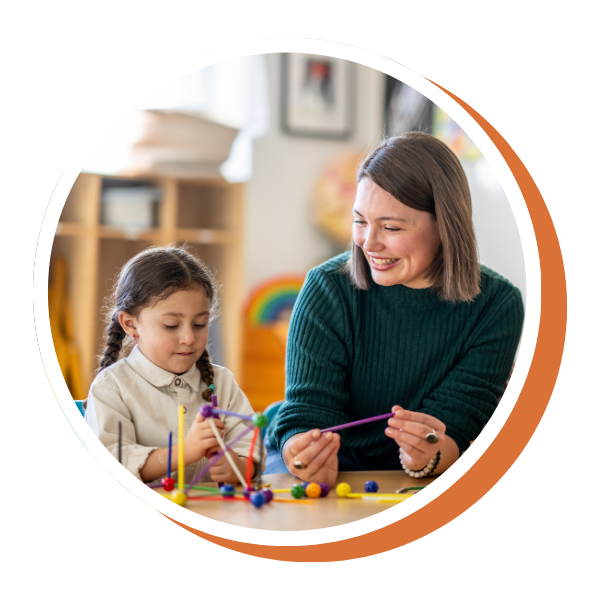
Montessori is focused on teaching for understanding. In a primary classroom, five to seven year olds receive the benefit of two years of sensorial preparation for academic skills by working with the concrete Montessori learning materials. This concrete sensorial experience gradually allows the child to form a mental picture of concepts like how big is a thousand, how many hundreds make up a thousand, and what is really going on when we borrow or carry numbers in mathematical operations.
The value of the sensorial experiences that the younger children (five to seven-year-olds) have had in Montessori have often been under-estimated by both parents and educators. Research is very clear that young children learn by observing and manipulating their environment, not through textbooks and workbook exercises. The Montessori materials give the child a concrete sensorial impression of abstract concepts, such as long division, that become the foundation for a lifetime understanding.

Focus on Deep Learning
Montessori teachers are well trained in child development and present information in developmentally appropriate ways.

Contrast to Rote Learning
In many American schools, children do exercises and fill in workbook pages, resulting in a great deal of rote learning. We like to focus more on hands-on specialized materials.

Retention and Application
Unlike superficial learning, which is quickly forgotten, a hands-on approach helps children retain knowledge and successfully apply their skills in new situations.

Concrete Foundations
The primary goal of the sensorial materials is to provide physical, manipulative representations that bridge the gap between concrete experience and abstract intellectual concepts.

Beyond Worksheets
While completing exercises can impress parents, Montessori focuses on deep, constructive work and mastery, ensuring the student truly understands the material rather than simply memorizing correct answers.

Essential Skills
Learning to be organized and learning to be focused is considered as important as any academic work.
Peer Tutoring, Independence, and Autonomy
In a class with such a wide age range of children, won’t my seven-year-old spend the year taking care of younger children instead of doing his or her own work?
The seven-year-olds in Montessori classes often help the younger children with their work, actually teaching lessons or correcting errors. Anyone who has ever had to teach a skill to someone else may recall that the very process of explaining a new concept or helping someone practice a new skill leads the teacher to learn as much, if not more than the pupil. This is supported by research. When one child tutors another, the tutor normally learns more from the experience than the person being tutored. Experiences that facilitate the development of independence and autonomy are often very limited in traditional schools.
Isn’t it Better for Kids to Go to School With the Children From Their Neighborhood?
Once upon a time people bought a home and raised their family in the same neighborhood. There was a real sense of community. Today, the average family will move two or three times before their children go off to college. Many public schools expect a turnover of more than 20% of their population a year as families move in and out of the area. The relationships that once bound families living in the same neighborhood together into a community have grown weak in many parts of the country.
In many Montessori schools, families who live in different neighborhoods but who share similar values have come together to create and enjoy the extended community of their school. Children growing up in Montessori schools over the last fifty years often speak of how closely knit their friendships were with their schoolmates and their families.
Transitioning in Kindergarten vs. First Grade. Why Wait?
Many families wonder if it is better for their child to transition to a neighborhood school's kindergarten program rather than staying in Montessori through first grade. The American Montessori Society shares the perspective of one parent who wrote, “We considered the school years ahead. We realized a child usually does his best if he has good learning habits, a sound basis in numbers and math, and the ability to read. We realized that he has had an excellent two-year start in his Montessori school. If he were to transfer now to kindergarten, he would probably go no farther than he is now, whereas if he stays in Montessori, he will reap the benefits of his past work under the enthusiastic guidance of teachers who will share his joy in learning.”
Many families are aware that by the end of the kindergarten year, Montessori students often develop academic skills beyond those of children in most American kindergarten programs. However, parents should remember that academic progress is not our ultimate goal. Our real hope is that the children will have an incredible sense of self-confidence, enthusiasm for learning, and will feel closely bonded to their teachers and classmates. We want much more than competency in the basic skills; we want them to honestly enjoy school and feel good about themselves as students. Once children have developed a high degree of self-confidence, independence, and enthusiasm for the learning process, they normally can adapt to all sorts of new situations. While there are wonderful reasons to consider keeping a child in Montessori through elementary school and beyond, by the time they are in first grade they will typically be able to go off to their new school with a vibrant curiosity and excitement about making new friends and learning new things.
If My Child Stays in Montessori for Kindergarten, Won’t They be Bored in a Traditional First-Grade Program?
Montessori children by the end of age five are typically curious, self-confident learners who look forward to going to school. They are normally engaged, enthusiastic learners who honestly want to learn and ask excellent questions. What teacher wouldn’t want a room filled with children like that? Well, truthfully, over the years, we have found some who consider these children “disruptive.” Disruptive, you ask? A polite, independent Montessori child, disruptive?
The Social/Behavioral Challenge
Because Montessori children have spent years being treated with honesty and respect, with their opinions and questions taken seriously, they can sometimes be seen as challenging authority in environments that enforce rigid rules (e.g., asking, "why do I have to ask each time I need to use the bathroom?" or "Why do I have to stop my work right now?"). The honest answer is that it depends on the teacher and school.
The Academic Challenge
From an academic viewpoint, Montessori children will generally be doing very well by the end of kindergarten (though, again, that isn't our primary goal). The program offers enriched lessons in math, reading, language, and cultural areas. When one of these children enters a traditional first grade, they may have already mastered the skills considered first-grade curriculum. Once, gifted children only had the option to skip grades, which caused social stresses. However, as Dr. Montessori’s strategies are adopted, it is becoming more common to find elementary schools that are willing and able to adapt their curriculum to meet the needs of individual students who are ready for accelerated work.
The key concept in Montessori is the child’s interest and readiness for advanced work. If a child is not developmentally ready to go on, they are not left behind or made to feel like a failure. Our goal is not to ensure a predetermined rate of development, but to ensure that whatever they do, they do well. Most Montessori children master a tremendous amount of information and skills. Even in the rare case where one of our children may not have made as much progress as we would have wished, he will usually be moving along steadily at his own pace and will feel good about himself as a learner.
The Lasting Advantage: A Foundation for a Lifetime of Learning
Choosing our Montessori kindergarten program for your five to seven-year-old at Patience Montessori offers benefits far beyond academics. This environment fosters enthusiasm, self-confidence, and independence by capitalizing on the child's developmental peak. By replacing rote learning with concrete, hands-on experiences, the program ensures the child develops deep understanding and strong knowledge retention, which is crucial for later complex thinking. The multi-age setting also promotes leadership and autonomy through peer tutoring. A child who completes the Montessori cycle through age seven gains a robust foundation of positive learning habits and self-mastery, making them adaptable, curious, and well-equipped to succeed in any educational setting. Do not hesitate to reach out to us if you have more questions and we highly recommend scheduling a tour and visiting us in person!